
Pruning
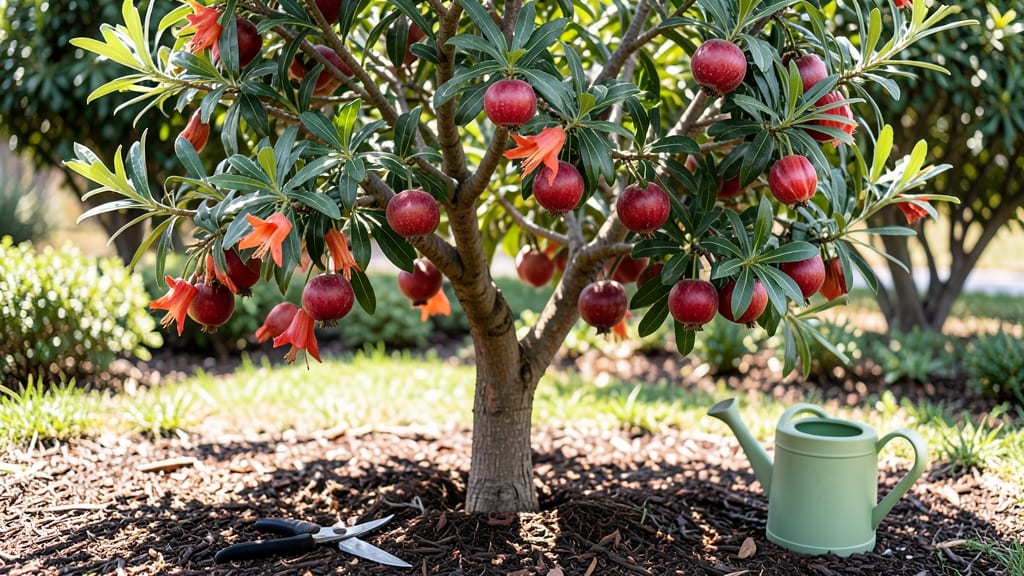
Choosing the right pomegranate tree varieties for small gardens means finding the perfect balance between fruit quality and space efficiency. I’ve grown ‘Wonderful’ and ‘Eversweet’ side by side—both produce stunning ruby-red jewels, but one thrives in tight corners while the other stretches taller.
The key lies in their growth habits: some stay under 6 feet, while others reach 12 feet without restraint.
‘Candy’ is my go-to for compact spaces—its 4-foot height and sweet-tart fruit make it ideal for containers or small yards. Meanwhile, ‘Mollar de Elche’ delivers large, seedless fruits but needs more room to shine.
Cold hardiness varies too: ‘Wonderful’ handles 20°F, while ‘Eversweet’ struggles below 25°F. Your climate dictates which variety will reward you with bursting, flavorful harvests year after year.
Once you pick your variety, pruning becomes your secret weapon. I trim mine in late winter to shape the tree and encourage fruit-heavy branches. Well-draining soil and full sun (6+ hours daily) keep these Mediterranean natives happy, even in hot summers.
The payoff? A backyard bursting with vibrant blooms and fruit so juicy, you’ll forget store-bought ever tasted this good.
For small gardens, focus on dwarf or semi-dwarf types—they’re just as productive but far easier to manage. Whether you’re growing in pots or along a fence, these varieties prove you don’t need acres to enjoy homegrown pomegranates.
Let’s dive into the specifics so you can pick the perfect match for your space.
📚 In This Guide
- What you need
- Instructions
- Tips and common mistakes
- Wrapping up and next steps
What you need
- ● Compact pomegranate tree varieties: Choose from cold-hardy picks like 'Wonderful' (dwarf grafted), 'Eversweet', or 'Mollar de Elche' (dwarf rootstock). Buy 1-3 trees for cross-pollination (if needed).
- ● Well-draining soil: 5+ gallons of a mix of 60% potting soil, 20% perlite, and 20% compost (or use native soil amended with sand/gravel).
- ● Container or planting site: For containers: 15–25 gallon pot (minimum 18" diameter) with drainage holes.
- ● For ground planting: Dig a hole twice as wide as the root ball but no deeper.
- ● Organic fertilizer: Slow-release 10-10-10 or 7-9-5 (1 lb per tree) + 1 cup bone meal (for phosphorus).
- ● Mulch: 2–3 inches of wood chips or straw (keep 4" away from the trunk).
- ● Required: Hand trowel or spade
- ● Pruning shears (sterilized with rubbing alcohol)
- ○ Garden gloves (optional but recommended)
- ● Watering can or hose with gentle spray nozzle
- ● pH test kit (ideal range: 5.5–7.0)
- ○ Optional (but helpful): Drip irrigation system or soaker hose
- ● Tree support stake (for young trees in windy areas)
- ● Reflective mulch (to deter pests)
- ● Cold frame or frost cloth (for winter protection in zones <8)
Selecting and cultivating compact pomegranate tree varieties for small spaces
Here’s how to choose and grow dwarf or semi-dwarf pomegranates that thrive in tight spaces.
Identify the Best Compact Varieties for Your Climate
Not all pomegranates are created equal when it comes to size. For small gardens, prioritize ‘Wonderful’ (semi-dwarf, 12–15 feet tall), ‘Eversweet’ (dwarf, 8–10 feet tall), or ‘Mollar de Elche’ (compact, 6–8 feet tall). These varieties produce large, sweet fruit while staying manageable in containers or narrow beds.
Check your USDA Hardiness Zone—most compact pomegranates tolerate Zones 7–11, but ‘Wonderful’ handles Zone 6 with winter protection. If you’re in a cooler area, opt for ‘Sweetheart’, a cold-hardy dwarf that matures at 6–8 feet. Always verify the variety’s mature height and spread before purchasing.
Prepare the Planting Site for Optimal Growth
Pomegranates need full sun (6–8 hours daily) and well-draining soil to prevent root rot. If your garden has heavy clay, amend the soil with 3–4 inches of compost and a 2-inch layer of coarse sand or gravel to improve drainage. Avoid low-lying areas where water pools after rain.
For container growing, use a 15–20 gallon pot with drainage holes and fill it with a mix of 50% potting soil, 30% perlite, and 20% compost. Place the pot in a location where it won’t be shaded by walls or larger plants. If growing in the ground, space 6–8 feet apart to allow airflow and prevent disease.
Plant and Establish Young Trees for Long-Term Success
Dig a hole twice as wide as the root ball but no deeper. Gently remove the tree from its container and loosen any circling roots with your fingers. Place it in the hole so the graft union (visible bump near the base) sits 2–3 inches above soil level—this prevents water from pooling at the trunk and causing rot.
Backfill with native soil, tamping lightly to remove air pockets. Water deeply until moisture reaches 12 inches down, then apply 2–3 inches of mulch (wood chips or straw) around the base, keeping it 6 inches away from the trunk. Young trees need consistent moisture—water 1–2 times per week during the first year, more often in dry, hot weather.
Prune and Train for Compact Growth Year-Round
Pruning isn’t just for shaping—it encourages strong branching and better fruit production. In late winter or early spring, remove dead, crossing, or weak branches using clean, sharp pruners. Cut just outside the branch collar (the swollen area where the branch meets the trunk) to promote healing.
To maintain a compact form, head back (shorten) the tallest branches by one-third in the first year. This redirects energy to lateral branches, creating a bushier tree. Avoid heavy pruning in summer or fall, as new growth won’t harden off before winter. Always sterilize your tools with rubbing alcohol between cuts to prevent bacterial infections.
Fertilize and Monitor for Pests/Diseases
Feed young trees with a balanced, slow-release fertilizer (10-10-10) in early spring, then switch to a low-nitrogen, high-phosphorus formula (5-10-10) once flowering begins. Apply ½ cup per year of tree age (e.g., ½ cup for a 1-year-old tree, 1 cup for a 2-year-old). Over-fertilizing leads to leafy growth at the expense of fruit.
Watch for aphids, scale, or whiteflies—common pests that suck sap and weaken trees. Spray infested areas with neem oil or introduce ladybugs for natural control. Fungal issues like powdery mildew appear as white, powdery patches on leaves. Improve airflow by thinning dense foliage and avoid overhead watering to keep leaves dry.
Tips & tricks for perfect compact pomegranate cultivation
Small spaces shouldn't limit your pomegranate dreams—these game-changing tips will help you maximize fruit production while keeping your trees manageable.
Variety Selection Wisdom: When choosing between ‘Wonderful’ (12-15 feet), ‘Eversweet’ (8-10 feet), or ‘Mollar de Elche’ (6-8 feet), consider your space constraints first. For true patio potential, ‘Mollar de Elche’ is my top recommendation—its compact size makes it perfect for containers while still delivering those signature sweet, juicy fruits. If you want slightly larger fruit, ‘Eversweet’ offers a great balance between size and manageability.
Soil Science Matters: The 50-30-20 soil mix (potting soil/perlite/compost) for containers is non-negotiable—it prevents root rot while providing optimal drainage. For in-ground planting, that 2-inch gravel layer under heavy clay is your secret weapon against waterlogged roots. I've seen pomegranates fail spectacularly when planted in unamended clay, so don't skip this step even if your soil looks "fine" at first glance.
Pruning Precision: That one-third branch reduction in the first year isn't arbitrary—it's how you train your tree to grow bushier from the start. Think of it like sculpting: you're directing energy toward lateral branches that will bear fruit. I recommend marking branches with a paint pen before cutting to visualize your compact shape. And always prune just outside the branch collar—this simple technique prevents unsightly stubs that can harbor disease.
Fertilizer Strategy: The ½ cup per year of tree age guideline is crucial, but timing matters just as much. Apply that first spring feeding when you see new growth emerge—usually in late February or March. For container trees, I like to mix a slow-release fertilizer into the soil at planting time, then top-dress with additional 5-10-10 in early spring. This two-pronged approach prevents the leafy growth explosion that comes from over-fertilizing.
Pro Tips for Pomegranate Tree Varieties
- Small spaces shouldn't limit your pomegranate dreams—these game-changing tips will help you maximize fruit production...
- Variety Selection Wisdom: When choosing between ‘Wonderful’ (12-15 feet), ‘Eversweet’ (8-10 feet), or ‘Mollar de Elch...
- Soil Science Matters: The 50-30-20 soil mix (potting soil/perlite/compost) for containers is non-negotiable—it preven...
Frequently asked questions
Got questions about growing compact pomegranate trees? You’re not alone! Here are answers to the most common queries to help you cultivate the perfect small-space pomegranate.
What’s the best compact pomegranate variety for beginners?
Start with ‘Wonderful’ or ‘Eversweet’—both are hardy, disease-resistant, and produce abundant fruit. For ultra-compact options, try ‘Mollar de Elche’ (dwarf variety) or ‘Dwarf Pomegranate’ (grafted to stay under 4-5 feet tall). All thrive in containers!
How long does it take for a compact pomegranate tree to bear fruit?
Patience is key! Most compact varieties fruit within 2–3 years after planting, but grafted dwarfs may take slightly longer (3–4 years). Ensure full sun (6+ hours/day), well-draining soil, and consistent watering to speed up the process.
Can I grow a pomegranate tree in a pot? What size container do I need?
Compact varieties thrive in pots—aim for a 15–20 gallon container with drainage holes. Use a mix of potting soil and perlite for aeration. Repot every 2–3 years and prune roots if they circle the pot. Just ensure the container is at least 18 inches deep for stability.
How cold-hardy are compact pomegranate trees?
Most compact varieties tolerate 15–20°F without issues, but young trees or grafted dwarfs may need winter protection (mulch or frost cloth). ‘Cold Hard Red’ is a top pick for zones 6–9—it’s one of the hardiest and still stays compact!
What pests or diseases should I watch for in small pomegranate trees?
Keep an eye out for aphids, spider mites, and pomegranate butterfly caterpillars (they love the leaves!). Fungal issues like powdery mildew can occur in humid climates—improve airflow by pruning and avoid overhead watering. Neem oil or insecticidal soap works for mild infestations.
Pro Tip: Prune in late winter to shape your tree and encourage fruit production. Remove dead wood and thin crowded branches—this keeps your compact pomegranate healthy and productive!
Wrapping up and next steps
Choosing the right pomegranate tree variety for your small garden can transform your space into a vibrant, low-maintenance oasis! From the Wonderful to the Eversweet, compact types offer delicious fruit and stunning blooms without the bulk.
Whether you prioritize dwarf varieties, cold hardiness, or unique flavors, there’s a perfect match for your needs.
Now that you’re armed with knowledge, take the next step: plant your pomegranate tree and enjoy the journey of watching it thrive! 🌱 With the right care, you’ll soon be harvesting juicy, antioxidant-rich fruit right from your backyard. Happy growing!